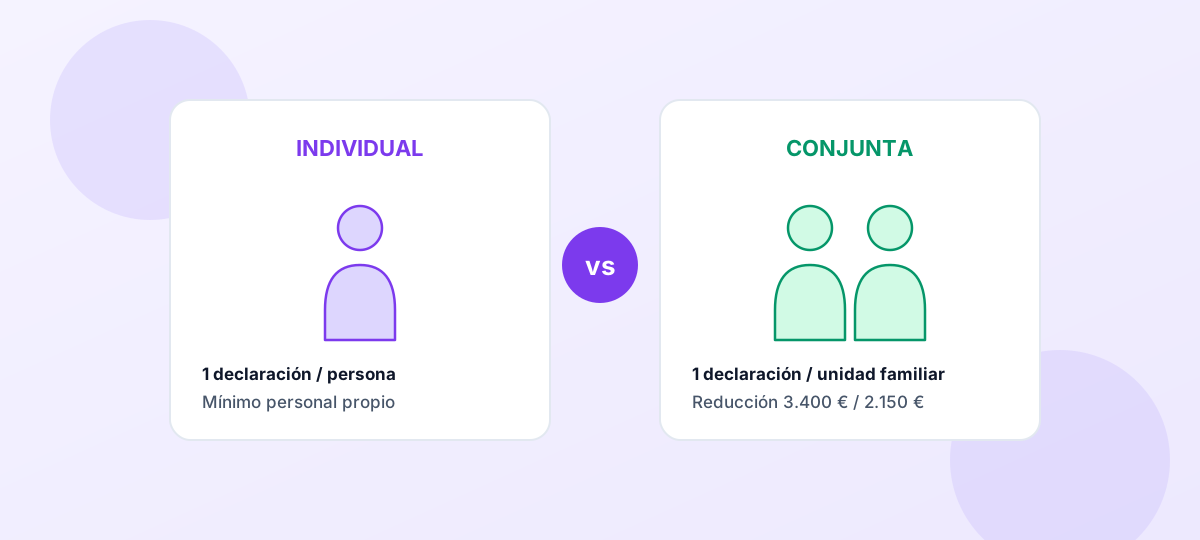
One of the most important — and most misunderstood — decisions of every tax campaign is choosing between joint and individual filing. Renta Web lets you simulate both options before confirming the draft, but it pays to understand what's behind the numbers to know which option suits you this year.
Who can choose
Joint filing is only available for the family units defined by the Spanish Personal Income Tax Act:
- Type 1 (married couple): spouses not legally separated and, where applicable, minor children living with them or adult children with judicially declared incapacity subject to extended parental authority.
- Type 2 (single-parent): in case of legal separation, divorce or absence of marriage, the father or mother together with all the children living with them.
Unmarried couples cannot file jointly unless there is a common child and they opt for the single-parent type. Only one of the parents may include the child in their joint return.
How the result changes when filing jointly
When you choose joint filing, the income and deductions of all family-unit members are added into a single return, and a specific reduction is applied to the taxable base:
| Filing type | Reduction on the taxable base |
|---|---|
| Joint — married couple | €3,400 |
| Joint — single-parent | €2,150 |
That reduction is what usually tips the balance. But beware: the personal allowance does not double when you combine two taxpayers — it remains €5,550 per joint return, not €11,100.
When joint filing usually pays off
- One spouse with no income or very low income (less than €3,400 per year). The reduction is used in full and you don't "lose" the personal allowance of the spouse without income.
- Pensioners with a single earner in the couple and moderate income.
- Single-parent families where the parent has middle-range income and the children have no income of their own.
When individual filing is better
- Both spouses with similar income above the allowance: combining them tends to push the base into higher IRPF brackets.
- When one spouse has capital losses or negative income: filing individually allows them to be offset on their own return without "diluting" the other spouse's result.
- If one spouse receives exempt income or income under special regimes (e.g. impatriate regime), it's worth reviewing individually.
How to simulate both options in Renta Web
- Access the draft via the AEAT e-Office or the AEAT app.
- Once the tax data is loaded, click "Summary of returns".
- Renta Web displays each spouse's individual result and the joint result, with the exact euro difference.
- Pick the most favourable option and confirm.
Binding choice
The option you choose binds every member of the family unit for that tax year and, once the filing deadline has passed, it is irrevocable for that tax period: it cannot be changed by any means. It can only be modified by filing a corrective self-assessment (ticking box [124]) within the filing campaign period itself.
Common mistakes when choosing
- Confirming the default option without comparing: the draft proposes whichever option AEAT calculates as more favourable, but doesn't take into account every regional deduction or personal circumstance.
- Forgetting to include income from minor children living with you who earn money (paid scholarships, occasional jobs): if it exceeds the limits, they must file individually and the family unit loses joint filing.
- Not reviewing regional deductions, which can apply differently under each filing type.
For more detail on the applicable allowances see our personal and family allowance guide and the 2025 IRPF news guide.