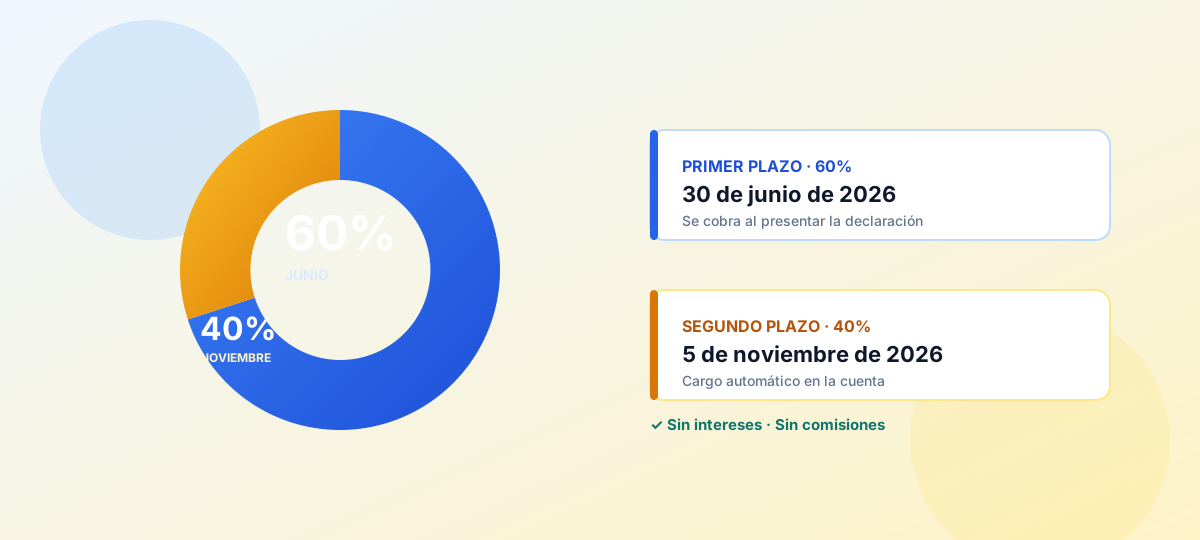
If your 2025 Spanish tax return (Renta 2025) shows a balance owed, the Tax Agency (AEAT) lets you split the payment into two instalments: 60 % when you file and 40 % in November, with no interest or fees. It's the most common way to avoid a single heavy charge and is available throughout the campaign, but many taxpayers either don't know it exists or confuse it with a formal payment deferral.
How the 60/40 split works
This isn't a new rule — it's an option AEAT has kept campaign after campaign and which remains widely unknown. When you confirm your return in Renta Web, if the result is a payment due a specific checkbox appears to split the payment. The process is automatic:
| Instalment | Amount | Charge date |
|---|---|---|
| First instalment | 60 % of the amount owed | 30 June 2026 |
| Second instalment | Remaining 40 % | 5 November 2026 |
Direct-debit dates
If you direct-debit the first payment, the return must be filed before 25 June. If you pay by another method (manual charge, card or NRC code), you can wait until 30 June.
No interest or surcharges apply as long as the dates are respected. You don't have to justify reasons or request authorisation — just tick the box when filing.
Who can use it and who can't
Available for:
- Any taxpayer with a balance owed on the 2025 return.
- Returns filed within the official deadline (up to 30 June 2026).
Not available for:
- Late supplementary returns for prior events: these don't allow automatic splitting.
- Not compatible with an individual payment deferral (which does carry interest and is processed separately) — you must pick one or the other.
- If you file after the deadline, you lose the 60/40 split and the amount owed triggers automatic surcharges.
Steps to request it in Renta Web
- When confirming the return in Renta Web, tick the "Fraccionar pago" box before validating.
- Direct-debit both instalments to the same bank account: it simplifies the automatic charges and prevents forgotten payments.
- Check you have sufficient balance on 30 June and 5 November.
- Keep the filing receipt, which shows both amounts broken down.
- If you change bank accounts before November, report it through the AEAT e-Office to prevent the direct debit from being rejected.
What happens if you miss the second instalment
Missing the second instalment means losing the benefit of the split. The consequences are automatic:
- The outstanding 40 % becomes debt with a 5 % surcharge if you regularise before AEAT issues a notice.
- If AEAT issues an enforcement order (providencia de apremio), the surcharge rises to 20 % plus late-payment interest (Article 28 of the General Tax Act).
- Your compliance record is degraded, which can affect future deferral requests.
Practical tip
Set a calendar alert for 28 October. One week of lead time before the charge is enough to adjust the account or request a change if needed.
Instalment split vs. individual deferral: key differences
They aren't the same thing. Worth distinguishing before choosing:
| Feature | 60/40 instalment split | Individual deferral |
|---|---|---|
| Interest | No interest | Statutory interest rate |
| Number of instalments | 2 fixed | Up to several months, negotiable |
| Maximum amount | No limit | Up to €50,000 without collateral |
| How to request | Checkbox in Renta Web | Separate request via Sede Electrónica |
| Compatibility | Excludes deferral | Excludes instalment split |
For most taxpayers, the 60/40 split is the better option. The individual deferral only makes sense when the amount owed is very large and six months aren't enough. The €50,000 threshold exempt from posting collateral is set by Order HFP/311/2023, of 28 March.
Regulatory context
Under the current Spanish Tax Agency rules for the 2025 campaign, the two-instalment split is the standard cost-free payment method for positive results. The option appears explicitly in the filing form and requires no additional request. Following AEAT's latest campaign notices, it's reiterated that choosing between the instalment split and an individual deferral is mutually exclusive.
If you're owed a refund instead
The schedule is different: AEAT has six months to issue the payment. See our guide on when the 2025 tax refund arrives for the usual timelines and how to track the status.