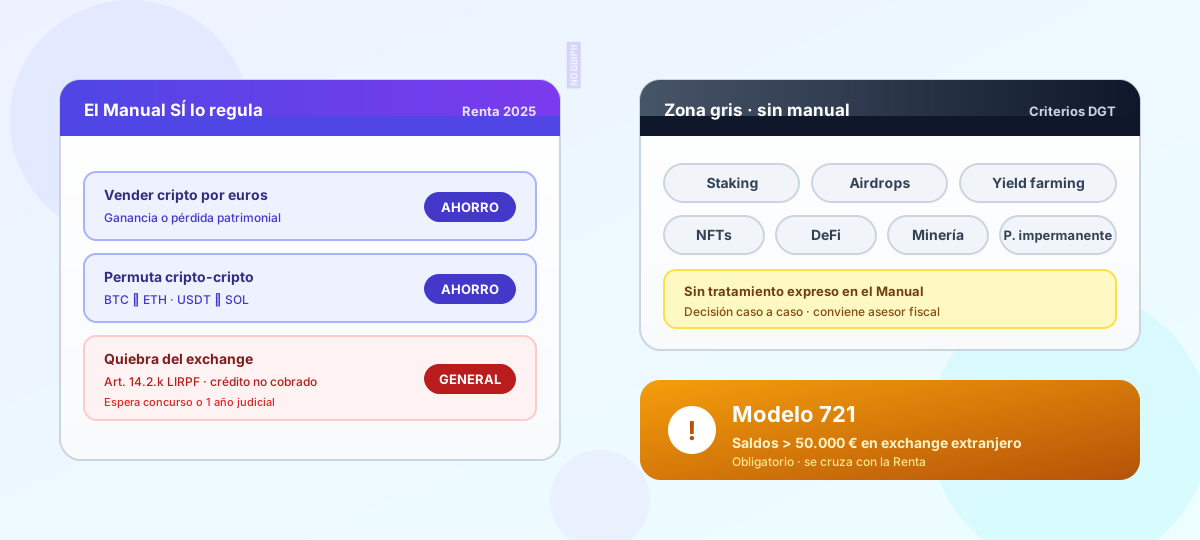
Thousands of crypto investors will file the 2025 personal income tax return without realising that Form 721 runs in parallel and that staking, airdrops, NFTs and DeFi travel without a manual. Spanish exchanges already report every balance and operation to the tax authority, and contributors holding crypto abroad must self-declare their balances. We explain what HAS clear rules, what stays in no man's land, and how to avoid the mistake that exposes all your operations.
What has changed?
The 2025 tax return confirms what has been building since Forms 172, 173 and 721 came into force: exchanges based in Spain report every balance and operation to the AEAT, and investors with crypto outside Spain must self-declare their holdings if they exceed the threshold.
The 2025 practical income tax manual only clearly regulates three operations:
| Operation | Taxed as | Tax base |
|---|---|---|
| Sell crypto for euros | Capital gain or loss | Savings |
| Swap bitcoin for ethereum (crypto-to-crypto) | Exchange — capital gain or loss | Savings |
| Your exchange goes bankrupt and funds are not returned | Unpaid claim (art. 14.2.k LIRPF) | General |
Everything else —staking, airdrops, mining, NFTs, yield farming, liquidity pools, impermanent loss— is not explicitly covered by the manual. Investors rely on the criteria of the Directorate-General for Taxes (DGT) in binding consultations, which are guidance only — they are not law and can change.
Notice to crypto investors
If at 31 December 2025 you held more than €50,000 in virtual currency balances custodied outside Spain, you must file Form 721 in addition to the income tax return. They are two separate returns that cross-check each other.
Who is affected?
- Anyone who sold crypto in 2025 —even a single €50 operation— must declare the gain or loss in the savings tax base section of the return.
- Anyone who swapped bitcoin for ethereum, USDT for SOL or any other crypto-to-crypto exchange, even without converting to euros. The operation is taxed at the moment of the exchange.
- Anyone holding crypto on foreign exchanges (international Binance, Coinbase, Kraken, etc.) with aggregate balance >€50,000 at 31 December → Form 721.
- Anyone who did staking, received airdrops, sold an NFT, provided liquidity in DeFi or earned yield farming: the manual does not explicitly cover them and the criterion depends on DGT consultations. It is advisable to seek tax advice before filing.
- Anyone who was a victim of an exchange bankruptcy (FTX, Celsius, etc.): the loss is not automatic and integrates into the general base, not the savings base.
What should you do?
- Download the tax statement from every exchange where you traded in 2025: dates, amounts in euros, fees and counterparty.
- Apply the mandatory FIFO criterion per type of cryptocurrency: the first units you purchased are deemed sold first, even if mentally you sold "others".
- Convert every crypto-to-crypto operation to its market value in euros at the exact date of the swap. Without this step you cannot compute gain or loss.
- Check whether you exceed the Form 721 threshold: add up all balances on foreign exchanges at 31/12/2025. If above €50,000, filing is mandatory.
- If you did staking, DeFi or sold NFTs: document each operation (date, amount in €, platform, counterparty) and consult a tax advisor before filing. The Directorate-General for Taxes classifies staking as movable capital income (binding consultation V1766-22) and airdrops as a capital gain in kind not derived from a transfer (binding consultation 0018-23), but these are guidance criteria and the final decision depends on the specific case.
- If your exchange went bankrupt: do not record the loss right away. You must wait for the insolvency document, the approved haircut, or the one-year judicial procedure without recovery required by art. 14.2.k LIRPF.
Key tip
The mistake that exposes everything
Spanish exchanges already send the tax authority Forms 172 and 173 with balances and operations. If you "forget" a sale or a swap, it is not that the tax authority might find out — they already know before you file. Declare everything even if the operation is small: the automatic data cross-check does not forgive.
Context
According to the official information published by the AEAT on its electronic seat, the informative forms on virtual currencies (172 on balances and 173 on operations) were approved by Order HFP/887/2023, of 26 July, and Form 721 on balances held abroad is part of the anti-fraud package derived from Law 11/2021, of 9 July. The 2025 practical tax manual only develops sale, exchange and loss due to non-return of funds by the platform. The specific taxation of DeFi operations, NFTs, staking, airdrops and yield farming is awaiting explicit regulatory development: current criteria come from binding consultations of the Directorate-General for Taxes and must be checked case by case.
Want to dig deeper
- Read our full guide on how to declare cryptocurrencies on the 2025 tax return for the detail of each operation.
- Review the key deadlines of the 2025 tax campaign before filing.
- If you already filed without declaring your crypto operations, see how to amend the return using box 103.