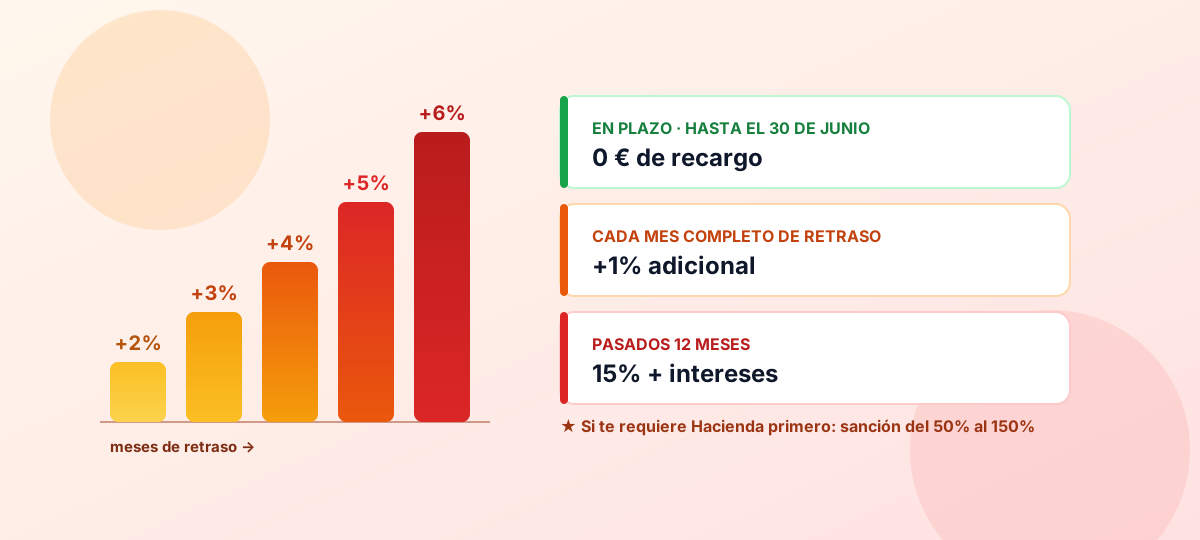
There are less than three weeks left to close the 2025 Spanish tax return (Renta 2025) campaign: the general deadline is 30 June 2026. Leaving it for later has a price. The moment you miss the date and your return shows a balance to pay, an automatic surcharge kicks in that rises every month. And there is a nuance many people don't know: if you wait for the Tax Agency (AEAT) to contact you first, it stops being a mild surcharge and becomes a much costlier penalty.
What happens if you file after 30 June?
When you file on your own, voluntarily and before the Tax Agency has demanded anything, the so-called late-filing surcharge applies. It works like a counter that keeps climbing:
| When you file (balance to pay) | Surcharge |
|---|---|
| On time (up to 30 June) | 0 % |
| Late but voluntary, within 12 months | 1 % fixed + 1 % for each full month of delay, with no interest |
| Late but voluntary, beyond 12 months | 15 % + late-payment interest |
The key word is voluntary: these mild surcharges only apply if you file before the Tax Agency demands it. On top of that, if you pay the surcharge on time and don't appeal it, you get a 25 % reduction.
The real scare: the Tax Agency catching you first
If you wait for the Tax Agency to send you a formal demand, this is no longer a surcharge but a penalty: between 50 % and 150 % of the amount you failed to pay (Article 191 of the General Tax Law, Ley 58/2003). A €1,000 balance that, filed late and on your own, would mean around €30 in surcharge can turn into €500 or more if the Tax Agency's letter arrives first.
Who does this affect?
- Anyone who hasn't filed yet and has a balance to pay: every month that passes makes the bill bigger.
- Anyone waiting on a document (a certificate, a property figure, a freelancer's invoice) thinking "I'll do it in July".
- Anyone who believes that filing late doesn't matter if they're due a refund: watch the nuance in the final tip.
What should you do?
- File before 30 June, even if you're not 100 % sure about some figure: you can always amend it afterwards with no surcharge.
- If you have a balance to pay and no cash on hand, don't use it as an excuse not to file: tick the 60/40 instalment split or request a deferral. The costly thing isn't owing money — it's not filing.
- If the deadline has already passed, file as soon as possible on your own: the fewer months of delay, the lower the surcharge and, above all, you avoid the penalty triggered by a demand.
- Remember that the deadline to set up direct debit for the payment ended on 25 June; after that you can still pay by other means (account charge, card or NRC).
If you're due a refund, breathe (a little)
The 1 %-per-month surcharge only applies to returns with a balance to pay. If your result is a refund, filing late doesn't trigger that surcharge, but it can still mean a formal fine of €100–200 and, above all, it delays your refund. File it anyway: it's your money waiting for you.
Context
According to the tax legislation in force —Article 27 of the General Tax Law (Ley 58/2003), in its current wording— and the AEAT's official calendar for the 2025 Renta campaign, the general filing deadline is 30 June 2026. Late-filing surcharges are automatic and are clearly distinct from penalties, which only apply when there is a prior demand from the Administration.