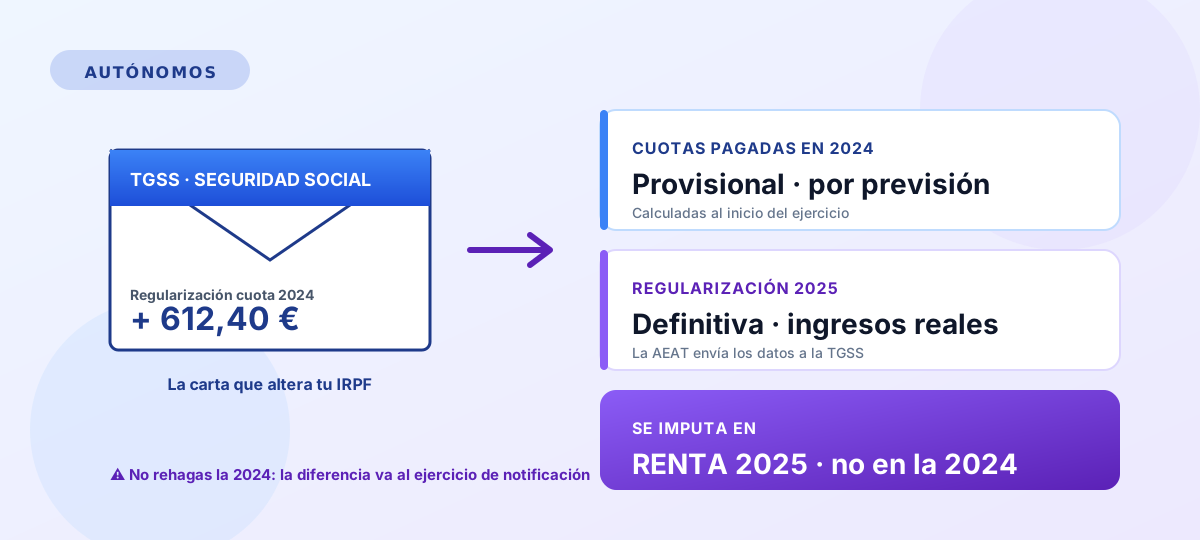
If you're self-employed under the direct-assessment regime, two letters can change your 2025 tax return — and neither of them is sent by the Tax Agency. They come from the Spanish Social Security Treasury (TGSS) and they reconcile the contributions you paid in 2024: either they claim a difference from you, or they refund you part of it. Either way, that figure feeds into your next IRPF return.
The surprise for many self-employed workers is where it goes: not into the 2024 tax return, already closed, but into the 2025 return they're about to file.
What has changed?
Since 2023, self-employed workers contribute according to real income within 15 brackets. The monthly contribution is only an estimate: Social Security reconciles it once it receives your actual reported income from the Tax Agency. The first mass reconciliation letters for the 2024 tax year went out in 2025 and are still arriving in 2026.
| Reconciliation outcome | What it means |
|---|---|
| Contributions to pay | Your real income exceeded the bracket you chose → TGSS claims the difference |
| Contributions to refund | Your real income was lower → TGSS pays you the difference |
The AEAT has clarified the tax effect: the difference is applied to the year in which the reconciliation is notified, not to the year the contributions correspond to.
Don't refile the 2024 return
Even though the contribution relates to 2024, the adjustment goes on the tax return for the year in which TGSS notifies it. Filing an amended 2024 return adds pointless work — and, in some cases, an unnecessary review.
Who is affected?
- Self-employed workers under direct assessment (standard or simplified) who paid RETA contributions in 2024.
- Those on flat-rate or reduced-rate contributions — the adjustment is calculated the same way.
- Corporate self-employed with a minimum contribution above the assigned bracket.
It does not affect those who already contributed at the maximum base or those under the modules regime (objective assessment).
What should you do in the 2025 tax return?
- If in 2025 you received a notice claiming a difference, add that amount as a higher deductible expense on your 2025 return.
- If the Treasury refunded contributions to you, record it as a lower expense on the 2025 return.
- If the notification arrives during 2026, it will go on the 2026 return.
- Keep the TGSS resolution with your accounting books: it's the proof of the adjustment.
- Before confirming the draft return, download the RETA contributions certificate from the Social Security e-office and check that it matches what you've recorded.
Key tip
The year of the letter rules
The rule is simple: the adjustment goes on the tax year in which TGSS notifies it. If the letter is dated 2025, it goes on the 2025 return. If 2026, on the 2026 one. That keeps the calculation simple and avoids amended returns.
Putting the wrong tax year is one of the most common mistakes by self-employed workers in this first phase of the real-income system.
Background
According to the rules published in the Spanish Official Gazette, the real-income contribution system was introduced by Royal Decree-Law 13/2022 and develops Article 308 of the General Social Security Act. Binding rulings from the Directorate-General of Taxes confirm that the reconciliation must be applied to the year of notification. TGSS is in full swing sending out the 2024 reconciliation notices. If, after the adjustment, your return comes out with a payment due, see how to split your 2025 tax return payment with no interest.