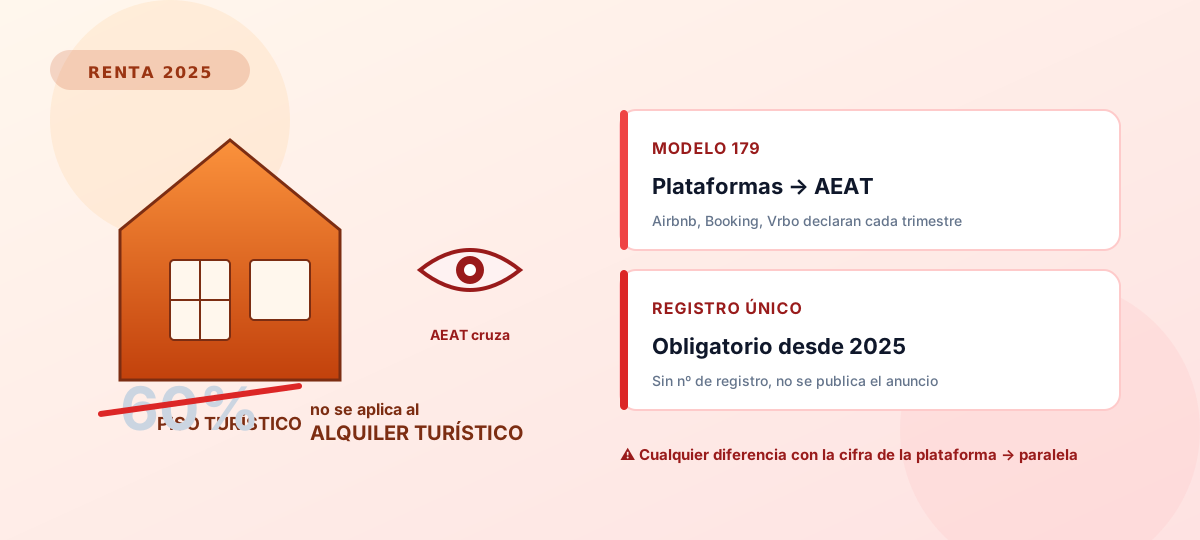
If you rented out your flat by the night in 2025 through Airbnb, Booking or any other platform, the platforms report what you earned to the Spanish Tax Agency (AEAT) through Form 238. Two rules that have come into force at the same time — the Single Rental Registry and Form 238 (DAC7) — have closed the loop: the AEAT holds that information to check it against what you declare.
The good news is that declaring it correctly isn't complicated. The bad news is that the most common mistake — applying the 60% reduction that only belongs to long-term residential leases — is still the number-one trigger of liquidations.
What has changed for 2025?
Two pieces are working in parallel for the first time this tax year:
- Single Rental Registry (Royal Decree 1312/2024): every property advertised for short-term rental needs a registration number from 2 January 2025. Platforms have been required to verify it since 1 July 2025.
- Form 238 (DAC7): once a year, Airbnb, Booking, Vrbo and similar platforms report to the AEAT who has been paid, for which property and for how many nights.
The result: the AEAT receives the income with name, surname, tax ID and property reference.
The Tax Agency already has the data
Through Form 238 the platforms report what you have been paid to the AEAT. This is information the Tax Agency holds to check against your return, so it's worth making sure the figures match.
Who is affected?
- Owners who rented out their property (whole or by rooms) by the day or week in 2025, on platforms or independently.
- Tenants who sublet with the owner's authorisation.
- Anyone managing several flats through an intermediary — the obligation falls on the owner regardless.
This regime does not apply to long-term residential leases or to justified seasonal contracts (students, displaced workers with proper contracts).
What should you do in the 2025 tax return?
- Download the annual fiscal report that the platform issues at year end.
- Add up every payment received during the year, including those handled by yourself or on platforms that have stopped operating.
- Subtract expenses pro-rated to the days rented: IBI, community fees, utilities, mortgage interest, insurance, 3% depreciation.
- Declare the result as real-estate capital income (rendimiento de capital inmobiliario).
- Don't apply the 60% reduction: that allowance is for long-term residential leases, not for tourist use.
- If you provided hospitality-style services (cleaning during the stay, reception, laundry, breakfast), that's an economic activity: register as self-employed and declare as business income.
- Make sure your listing carries the Single Rental Registry number. Without it, the platform shouldn't publish it.
Key tip
Cross-check before you confirm
Before filing your return, compare your figure with the platform's fiscal report. The AEAT already has exactly that same data. If you declare less, a parallel assessment with surcharge follows. If you declare a little more for safety, nothing happens — on the contrary, it shields you against a review.
The asymmetry is total: you can't hide income; the platforms have already reported it for you.
Background
According to the rules published in the Spanish Official Gazette, the new framework rests on Royal Decree 1312/2024, which created the Digital One-Stop Shop and the Single Rental Registry, and on Royal Decree 933/2021 on communication of traveller data. The platform reporting obligation is governed by the DAC7 rules (Royal Decree 117/2024 and Order HAC/72/2024, Form 238), which replaced the former Form 179. The AEAT tax-return manual confirms that short-term rentals are taxed as real-estate capital income, without the reduction reserved for long-term residential leases, unless hospitality services convert the activity into a business. If the result is a payment, see how to split your 2025 tax return payment with no interest.